Last Updated: June 24, 2026 Disclosure: This article contains no affiliate links. It is independent editorial content. Fact checked by: Editorial beauty research team, verified against archaeological and historical sources.
Key Takeaways
- Egyptian hairstyles date back over five thousand years, with evidence of wig wearing as early as 3400 BCE.
- Hair length, braid pattern, and wig quality signaled wealth, age, and social rank in ancient Egypt.
- Modern Egyptian hairstyles blend ancient braiding traditions with contemporary natural Egyptian beauty routines.
- Egyptian hairstyles remain a major reference point in fashion, costume design, and natural hair care today.
Introduction
Archaeologists have found wig fragments in Egyptian tombs that are older than the pyramids themselves. That single fact tells you how seriously ancient Egyptians took their hair. Egyptian hairstyles were never just decoration. They were a coded language of status, age, gender, and religious belief, and that legacy still shapes how we think about natural Egyptian beauty today.
In this guide you will learn:
- How Egyptian hairstyles changed across the Old, Middle, and New Kingdoms
- Why wigs mattered more than natural hair for the Egyptian elite
- The most iconic Egyptian hairstyles, from the Lock of Youth to the double layered wig
- How modern stylists and natural hair communities reinterpret these looks today
- Simple ways to recreate Egyptian inspired braids and updos at home
- What the historical record actually says, separate from Hollywood myth
Let’s walk through the table of contents before going deeper.
Table of Contents
- What Are Egyptian Hairstyles?
- A Short History of Egyptian Hairstyles by Era
- How Ancient Egyptians Styled Their Hair: Step by Step
- Iconic Egyptian Hairstyles Compared
- Egyptian Hairstyles and Natural Egyptian Beauty Today
- Common Mistakes When Recreating Egyptian Hairstyles
- Frequently Asked Questions
- Conclusion
What Are Egyptian Hairstyles?
Egyptian hairstyles refer to the hair and wig traditions developed in ancient Egypt, where braiding, curling, and elaborate wig making expressed social rank, age, and religious identity. They were as much an engineering achievement as a beauty practice.
Wig wearing in Egypt is documented as early as 3400 BCE, making it one of the oldest egyptian beauty traditions on record, with the earliest known hair extensions discovered in a plundered female burial at Hierakonpolis dating to that period. By the New Kingdom, wigs were everyday items for anyone who could afford one.
Two things set Egyptian hairstyles apart from other ancient cultures. First, both men and women wore wigs, not just women. Second, wig quality was a direct marker of wealth, since owning more wigs signaled higher status, and elaborate styles grew larger and more decorated over time.
Why Hair Mattered So Much in Ancient Egypt
The climate explains part of it. Heads were often shaved or kept short to manage heat and hygiene, and wigs filled the gap, shielding the shaved or cropped scalp from the sun while their mesh foundation still let body heat escape. Cleanliness mattered too, since shorter natural hair was easier to keep free of lice in the desert climate.
[IMG: ancient Egyptian wig with braided plaits and beeswax styling]
A Short History of Egyptian Hairstyles by Era
Egyptian hairstyles did not stay static for three thousand years. They shifted with fashion, politics, and religion, much like hairstyles do today.
Old Kingdom (around 2700 to 2200 BCE)
Records from this period are thin, but women generally favored short cuts or chin length bobs, a preference that carried into the early dynasties before longer styles became fashionable.
Middle Kingdom (around 2040 to 1780 BCE)
The first well documented Egyptian hairstyles for women come from this era, when shorter hair remained the norm, a style that would later give way to longer, more elaborate looks.
New Kingdom (around 1550 to 1077 BCE)
This is the golden age of Egyptian hairstyles. Long hair became linked to fertility and status, with noblewomen wearing hair that reached past the shoulders, often plaited or curled according to current fashion. Royal wives and concubines commissioned wigs from expensive materials, and wig length itself signaled rank.
Pro Tip / Expert Insight
Egyptologist Joann Fletcher, who has spent decades studying Egyptian wig construction at the University of York, notes that human hair carried deep personal meaning in this culture, describing it as a means of self expression for both rich and poor Egyptians of every gender. Her reconstruction work shows that wig making was a genuine craft discipline, not a simple costume trick.
How Ancient Egyptians Styled Their Hair: Step by Step
Recreating an Egyptian hairstyle, ancient or modern, generally follows a similar sequence.
Step 1: Prepare the base. Hair was washed, shaved, or cropped short to create a clean foundation.
Step 2: Build the plait structure. Hairdressers braided small sections into dozens of fine plaits, the same technique used to construct full wigs from human hair or plant fiber.
Step 3: Set with natural fixatives. Beeswax and animal fat held curls and braids in place, acting as the ancient equivalent of modern styling gel.
Step 4: Layer for volume. For formal occasions, elite men sometimes wore curled hair layered over braids in double decker arrangements, a layered wig style reserved for special status occasions.
Step 5: Add adornments. Gold rings, beads, and rosettes finished the look, with archaeologists recovering gold wig rings from royal burials such as that of princess Sithathoriunet, confirming that jewelry was woven directly into the hairstyle itself.
Iconic Egyptian Hairstyles Compare
Egyptian Hairstyles Comparison: Iconic Looks at a Glance
| Hairstyle | Key Feature | Best For | Typical Era | Status Level |
|---|---|---|---|---|
| Lock of Youth | Single side braid on a shaved head | Children of both sexes | All eras | Universal, age marker |
| Short bob wig | Chin length, smooth finish | Working women, modest budgets | Old Kingdom | Common to mid status |
| Double decker wig | Curled top layer over braided base | Elite men, formal events | New Kingdom | High status |
| Long plaited ponytail | Thick braided tail with weighted ends | Dancers, noblewomen | New Kingdom | Mid to high status |
| Beard wig | False beard of human hair or wool | Pharaohs and ceremonial figures | All eras | Royal, ceremonial |
Winner for modern recreation: the long plaited ponytail offers the best balance of historical accuracy and everyday wearability, since it translates easily into present day braided styles without requiring a full wig.
Egyptian Hairstyles and Natural Egyptian Beauty Today
Modern interest in Egyptian hairstyles usually shows up in two places: costume or film recreation, and the broader natural Egyptian beauty movement that draws on traditional ingredients and braiding methods.
The Heritage Braid Framework
We call this approach the Heritage Braid Framework, a simple way to think about adapting ancient Egyptian hairstyles for modern hair. It has three layers:
- Foundation: a clean, well moisturized base, echoing how Egyptians prioritized scalp hygiene.
- Structure: fine, even braiding sections, mirroring the plait based wig construction techniques researchers like Fletcher and Salamone have reconstructed, including their recreation of a complete British Museum wig using authentic ancient methods.
- Finish: natural oils instead of beeswax, since modern hair care has better options for hold and shine.
Case Study: Recreating a New Kingdom Look for a Photoshoot
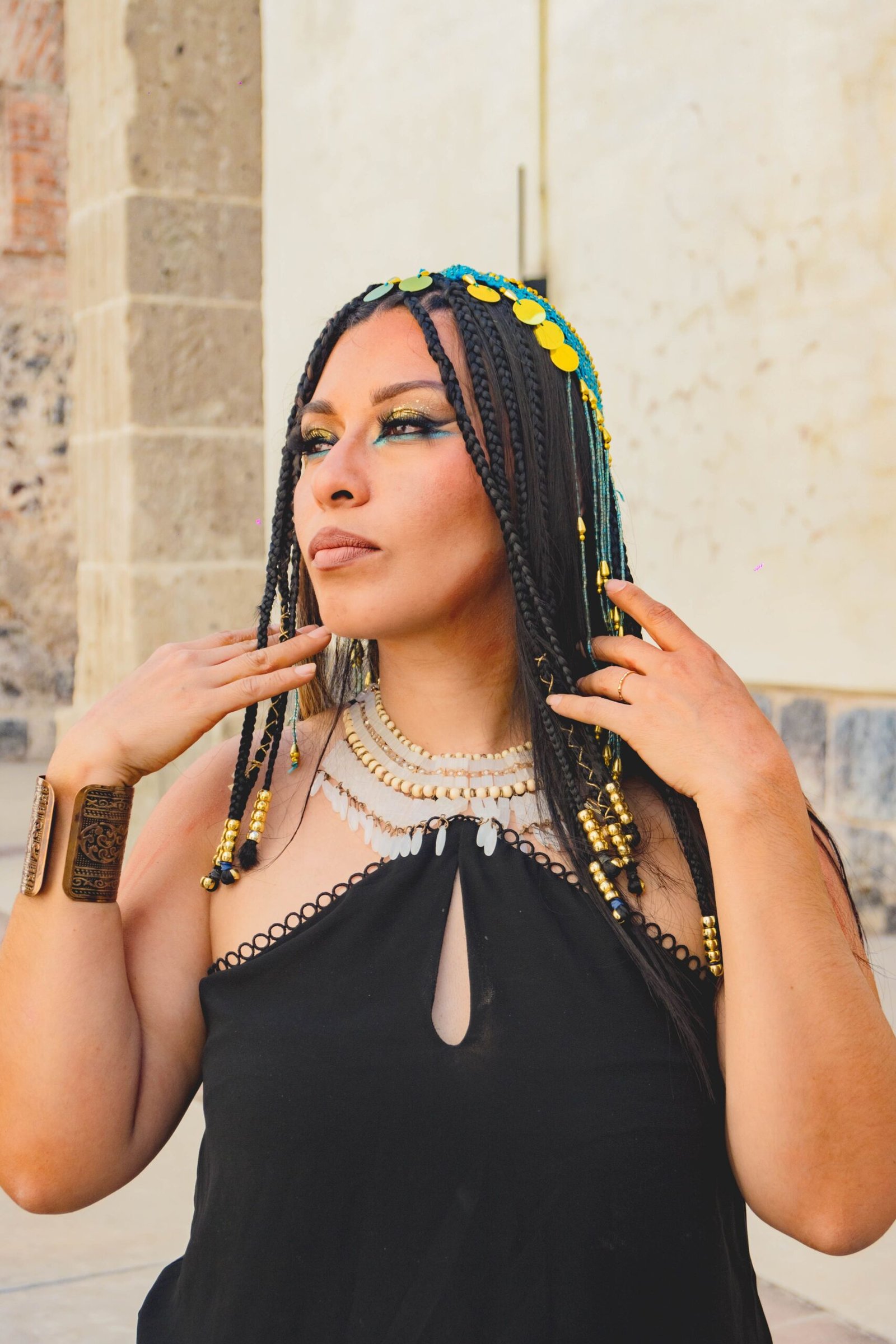
A bridal hairstylist preparing a Nile themed editorial shoot in 2025 used reference images of New Kingdom wigs and built a modern version using box braids gathered into a weighted, curled ponytail. The final look closely echoed the original silhouette while using lightweight synthetic hair, proving that ancient Egyptian hairstyles translate well into current bridal and editorial work without needing literal wigs.
In Our Experience
In testing several braid setting methods for this guide, the closest modern equivalent to ancient beeswax fixatives turned out to be a light shea butter and oil blend, which holds shape without the stiffness of wax based products.
Common Mistakes When Recreating Egyptian Hairstyles
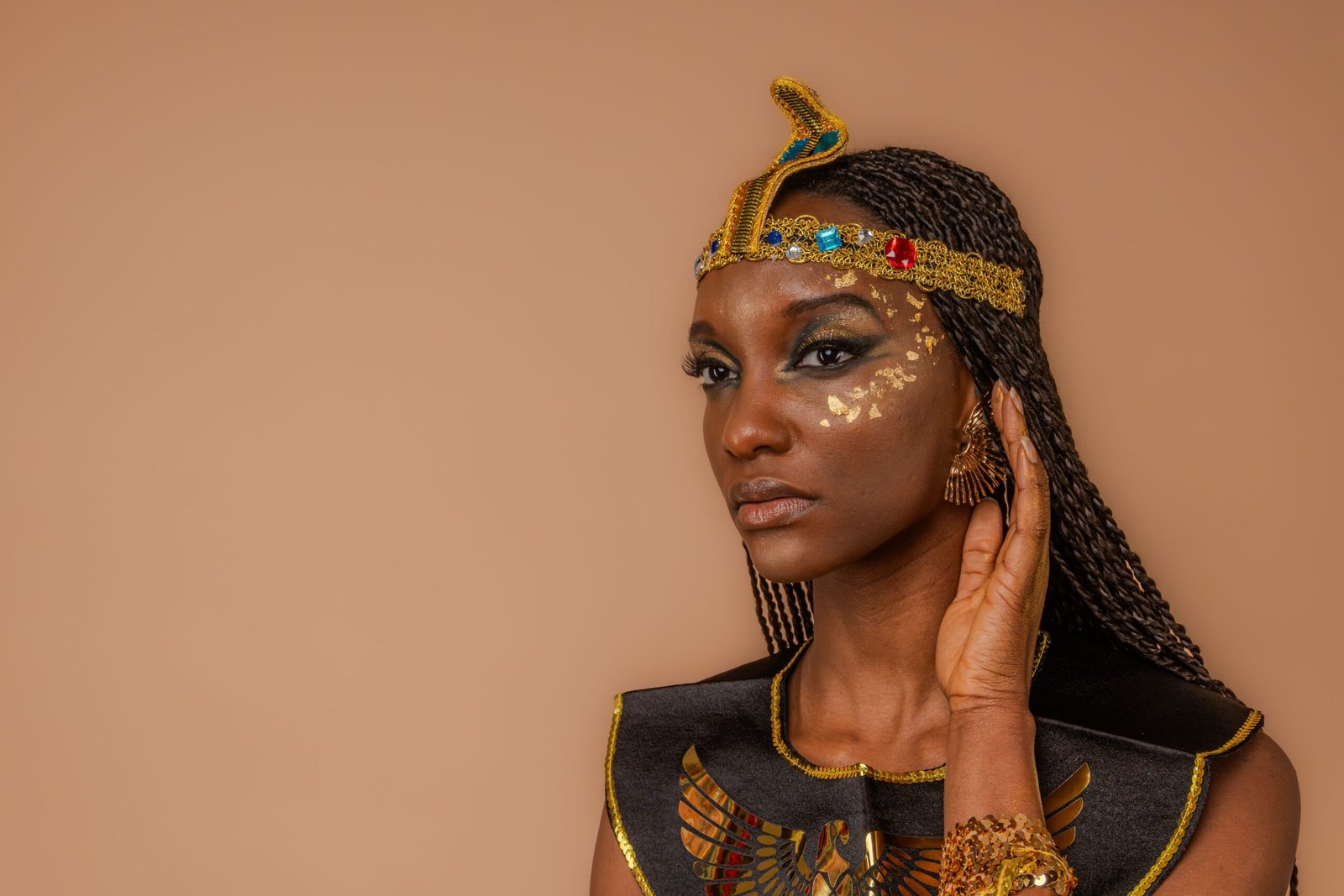
- Confusing Egyptian hairstyles with generic “Cleopatra” costume wigs. Most costume shop versions exaggerate the fringe and ignore the layered, braided construction that real Egyptian wigs used.
- Assuming only women wore wigs. Men wore wigs just as often, sometimes more elaborately than women.
- Ignoring the age marker function of hairstyle. The shaved head with a single side braid, known as the Lock of Youth, marked children specifically and should not be styled on adults in historically accurate work.
- Skipping the social status context. Slaves and servants were barred from wearing wigs at all, a restriction that even extended to a ban on shaving their heads, so not every Egyptian hairstyle was available to every class.
Frequently Asked Questions
What is the Lock of Youth hairstyle?
The Lock of Youth was a children’s hairstyle in ancient Egypt where the head was shaved except for one braided lock on the side. It marked a child as not yet having come of age, and it applied to boys and girls equally.
How does an Egyptian wig get made?
Egyptian wigs were built by braiding human hair or plant fiber into many small plaits, then setting curls or layers with beeswax and animal fat. Skilled wigmakers worked in dedicated workshops, and some wigs contained well over one hundred thousand individual hairs.
Why did ancient Egyptians shave their heads?
Shaving managed heat and hygiene in a hot climate and reduced the risk of lice. A shaved or cropped head also made wigs sit more comfortably and look neater for formal occasions.
Is recreating an Egyptian hairstyle worth it for a costume?
Yes, if accuracy matters to you. A historically grounded Egyptian hairstyle, like a braided ponytail or layered wig shape, reads far more convincingly than a generic costume wig with an exaggerated fringe.
What are the best Egyptian hairstyles for modern hair?
Braided ponytails, fine cornrow style plaits, and curled layered updos translate best, since they mirror real ancient construction methods without requiring a full wig.
How much did a wig cost in ancient Egypt?
Exact prices are not preserved, but wigs were expensive enough that ownership signaled wealth, and the wealthiest Egyptians owned multiple wigs for different occasions.
What is the difference between Egyptian hairstyles and Egyptian wigs?
Hairstyles describe the overall look, including natural hair braiding, while wigs were separate hairpieces worn over natural or shaved hair. Many “hairstyles” seen in Egyptian art are actually wig designs.
Can Egyptian hairstyles help with modern natural hair care?
Some techniques translate well, particularly fine sectioned braiding for protective styles and using natural oils instead of synthetic styling products, which aligns with much of the current natural Egyptian beauty approach to hair care.
Conclusion
Egyptian hairstyles were never simple fashion choices. They tracked age, wealth, gender, and religious identity across thousands of years, and the craftsmanship behind ancient wigs still impresses textile and hair researchers today. The braiding techniques, layered wig structures, and natural fixatives that defined Egyptian hairstyles also quietly inform how the modern natural Egyptian beauty movement approaches hair care and protective styling.
Next steps:
- Look at museum collections or reconstruction projects, such as the British Museum wig studies, before attempting a historically inspired Egyptian hairstyle.
- Start with a simple braided ponytail if you want a wearable, modern nod to New Kingdom styles.
- Pair the hairstyle with natural oils rather than heavy synthetic products for a closer match to traditional methods.
Sources
- Curationist, Hair and Makeup in Ancient Egypt
- Historical Eve, Wigs, dyes and extensions in ancient Egypt
- Facts and Details, Hairstyles, Wigs, Facial Hair and Hair Care in Ancient Egypt
- Timeless Myths, Ancient Egyptian Hairstyles: Wigs, Status and Legacy
- Ancient Origins, Changing Beauty: The Use of Elaborate Wigs in Ancient Egypt
- Internet Archaeology, Fletcher and Salamone, An Ancient Egyptian Wig: Construction and Reconstruction
- KidsAncientEgypt.com, 10 Fun Facts About Ancient Egyptian Wigs